Pearson Edexcel · GCSE · English Literature
Shakespeare Play (choice of: Macbeth, The Tempest, Romeo and Juliet, Much Ado About Nothing, Twelfth Night, The Merchant of Venice)
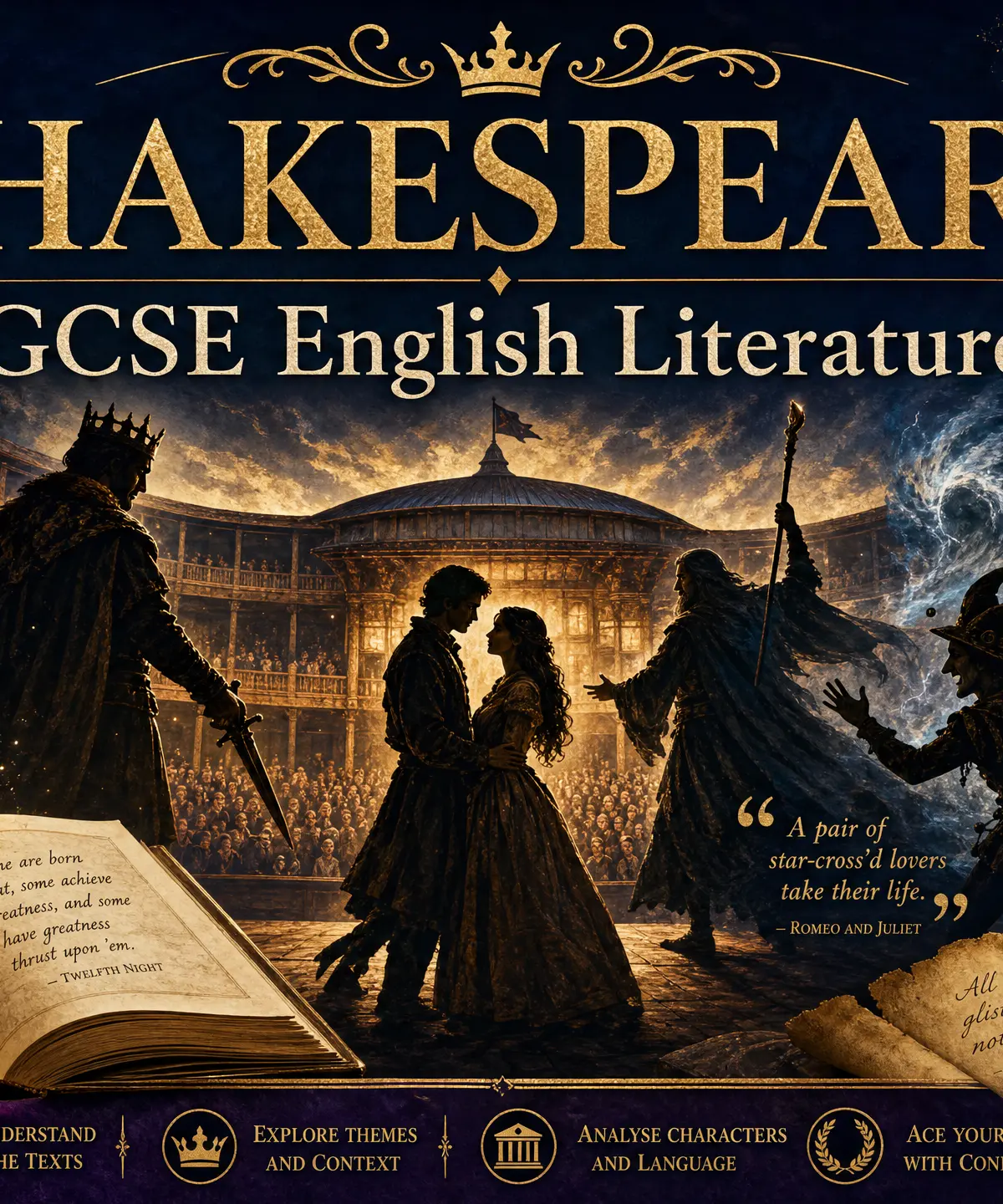
Master the Shakespeare component of your GCSE English Literature exam. This guide covers all six prescribed plays, teaching you how to analyse language, structure, and context to secure top marks.
- 6 min read
- 2 worked examples
- 4 practice questions
- 8 key terms
Study Notes
Overview
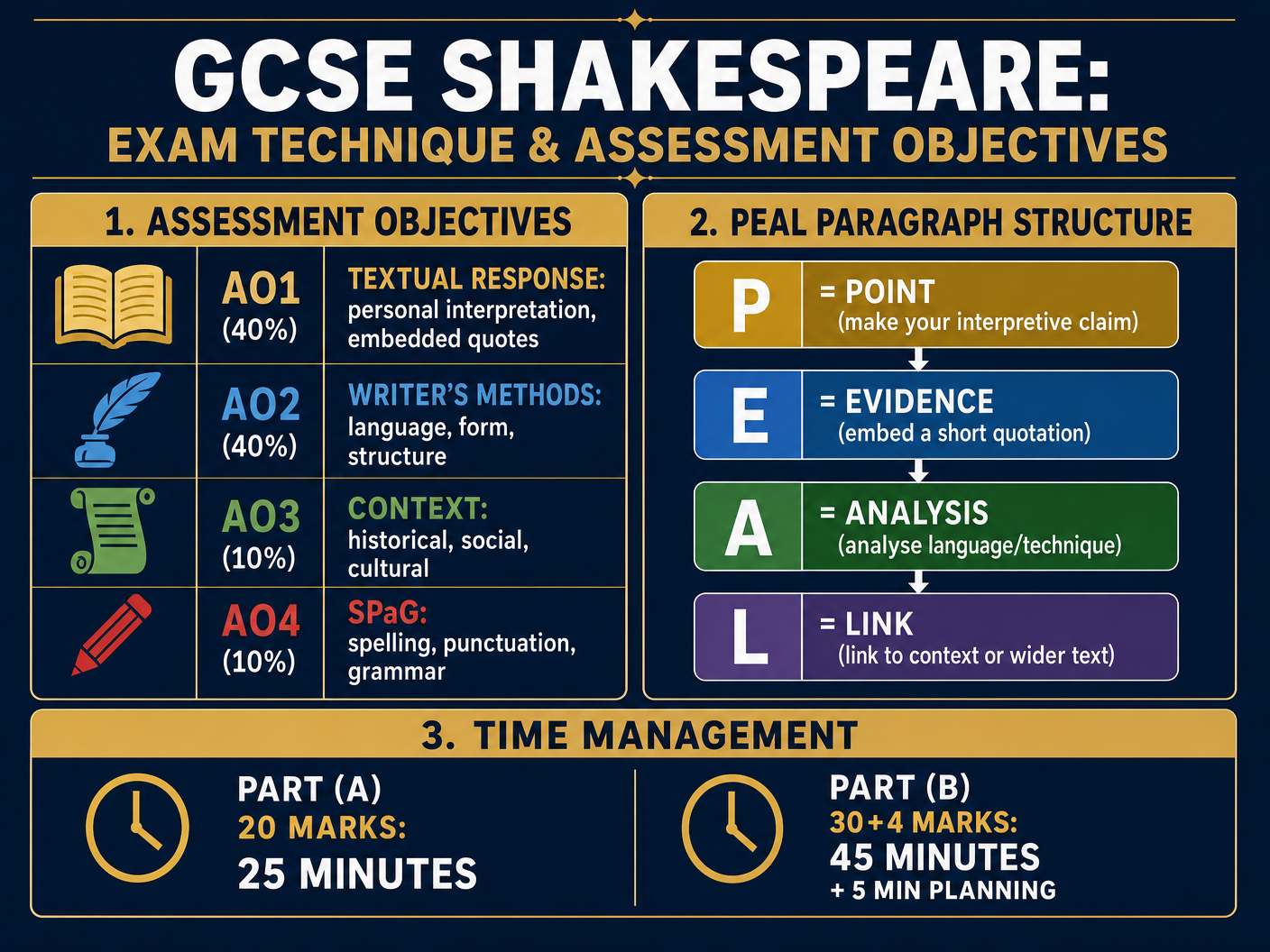
The Shakespeare component (Component 1, Section A) is a cornerstone of your GCSE English Literature qualification. Examiners are looking for a conceptualised personal response, precise analysis of Shakespeare's methods (language, form, and structure), and a thoughtful integration of historical context. You will be assessed on your ability to closely analyse a printed extract (Part a) and then connect a central theme or character from that extract to the wider play (Part b).
Listen to our revision podcast for an in-depth walkthrough of the exam strategy:

Plot/Content Overview
While you will only study one play, understanding the structural conventions of Shakespearean drama is essential. Most plays follow a five-act structure (Freytag's Pyramid):
- Act 1: Exposition – The status quo is established and the inciting incident occurs (e.g., the witches' prophecy in Macbeth, the street brawl in Romeo and Juliet).
- Act 2: Rising Action – Complications arise and the protagonist makes critical decisions.
- Act 3: Climax – The turning point of the play (e.g., Banquo's murder, Mercutio's death).
- Act 4: Falling Action – The consequences of the climax begin to unravel the protagonist's world.
- Act 5: Resolution/Denouement – Order is restored, usually through tragedy (death) or comedy (marriage).
Themes
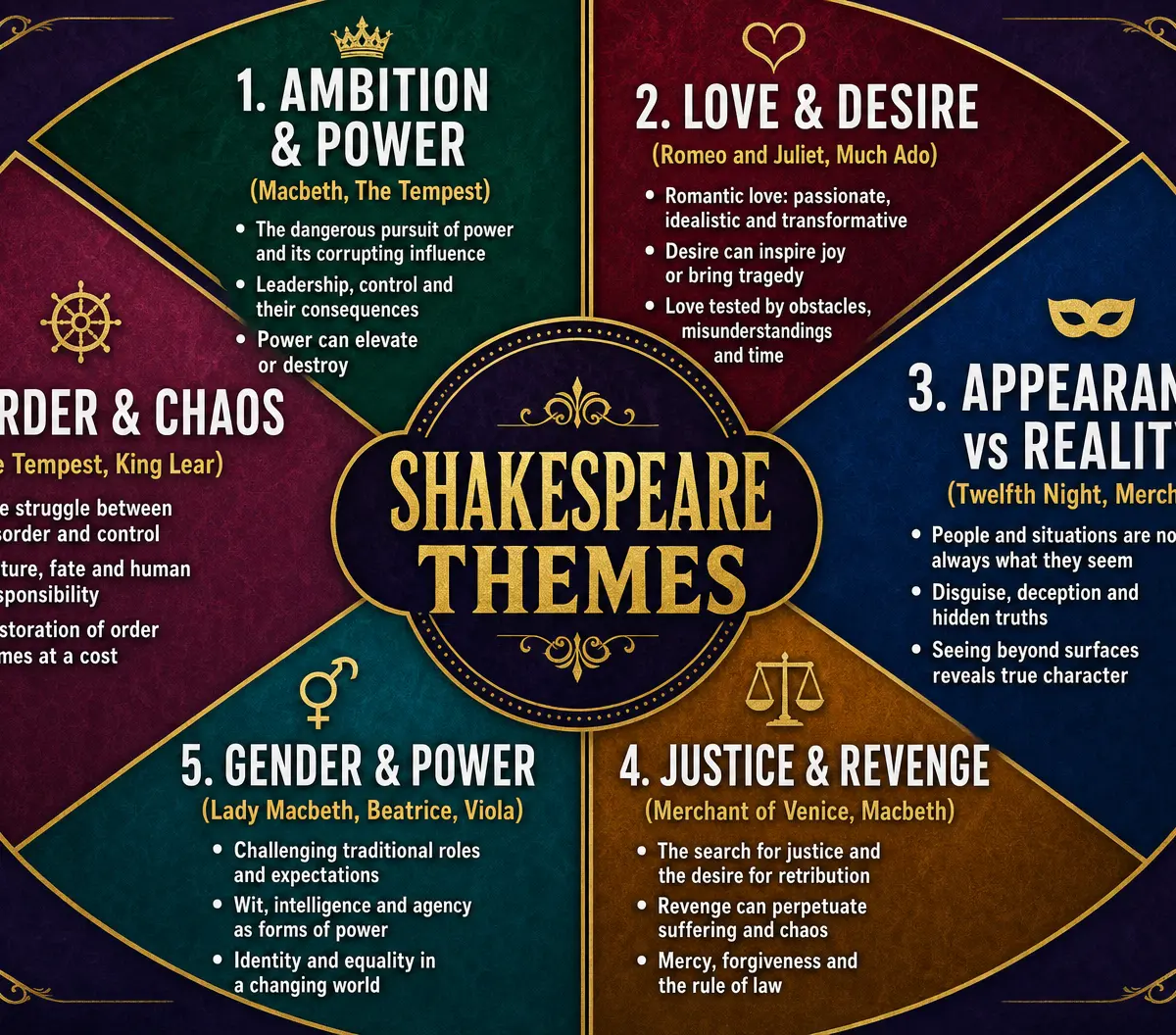
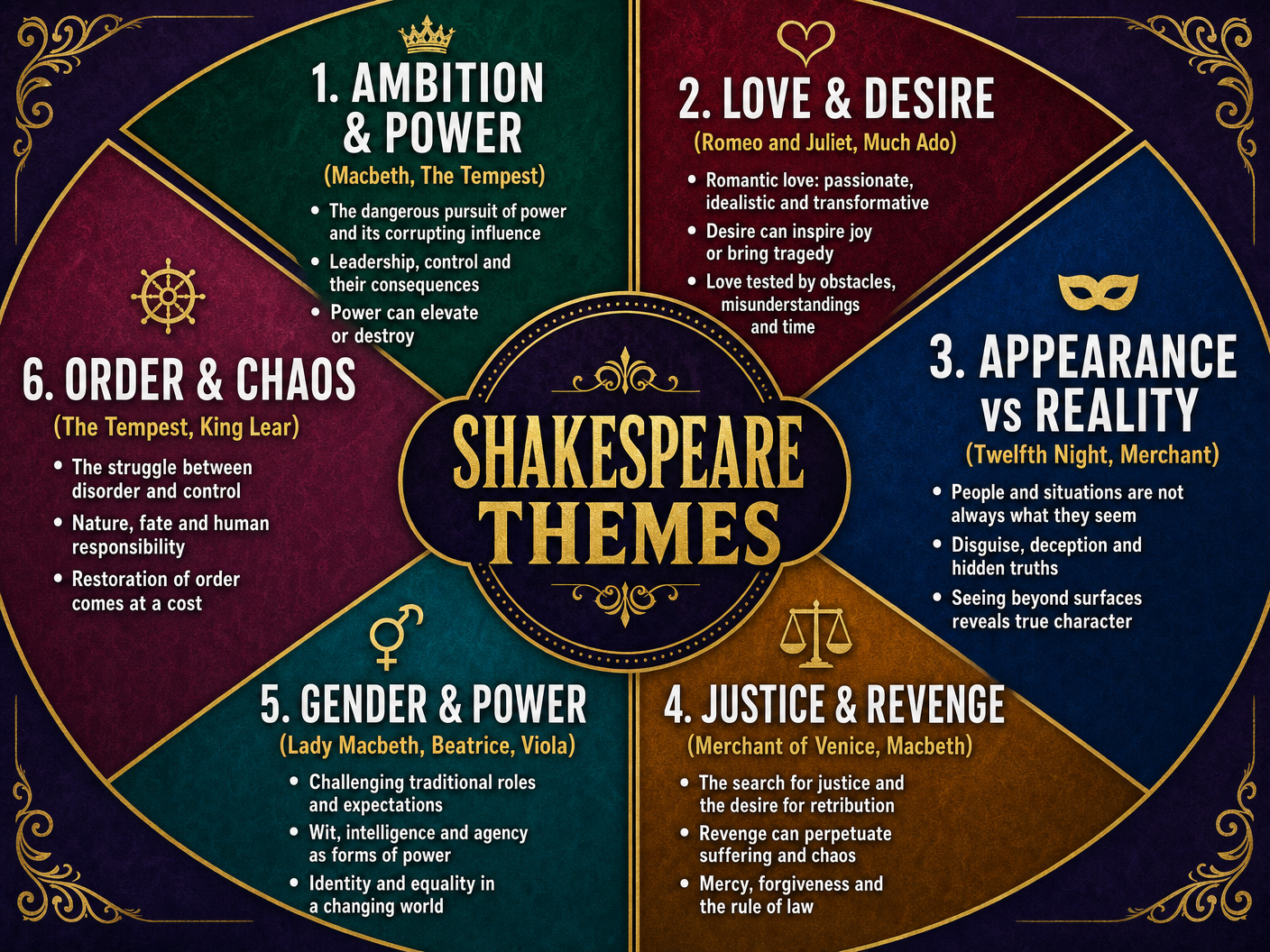
Theme 1: Ambition and Power (Macbeth, The Tempest)
Shakespeare frequently explores the corrupting nature of unchecked ambition and the responsibilities of power. In Macbeth, ambition disrupts the Great Chain of Being, leading to psychological and national collapse. In The Tempest, power is explored through colonialism and control.
Key Quotes:
- "Stars, hide your fires; let not light see my black and deep desires" (Macbeth, Act 1) - The juxtaposition of light and dark highlights the moral compromise of ambition.
- "You taught me language, and my profit on't is I know how to curse" (The Tempest, Act 1) - Highlights the oppressive nature of colonising power.
Theme 2: Love and Conflict (Romeo and Juliet, Much Ado About Nothing)
Love is rarely simple in Shakespeare. It is often intertwined with violence, social expectation, or deception.
Key Quotes:
- "A pair of star-cross'd lovers take their life" (Romeo and Juliet, Prologue) - The adjective 'star-cross'd' immediately establishes fate as the ultimate antagonist to their love.
- "I had rather hear my dog bark at a crow than a man swear he loves me" (Much Ado About Nothing, Act 1) - Beatrice uses hyperbolic prose to reject the restrictive conventions of courtly love.
Theme 3: Appearance vs Reality (Twelfth Night, The Merchant of Venice, Macbeth)
Deception—whether through literal disguise, manipulation, or self-delusion—is a central motif.
Key Quotes:
- "Fair is foul, and foul is fair" (Macbeth, Act 1) - The witches' paradoxical chiasmus establishes a world where moral certainty is inverted.
- "All that glisters is not gold" (The Merchant of Venice, Act 2) - A warning against superficial judgements.
Character Analysis
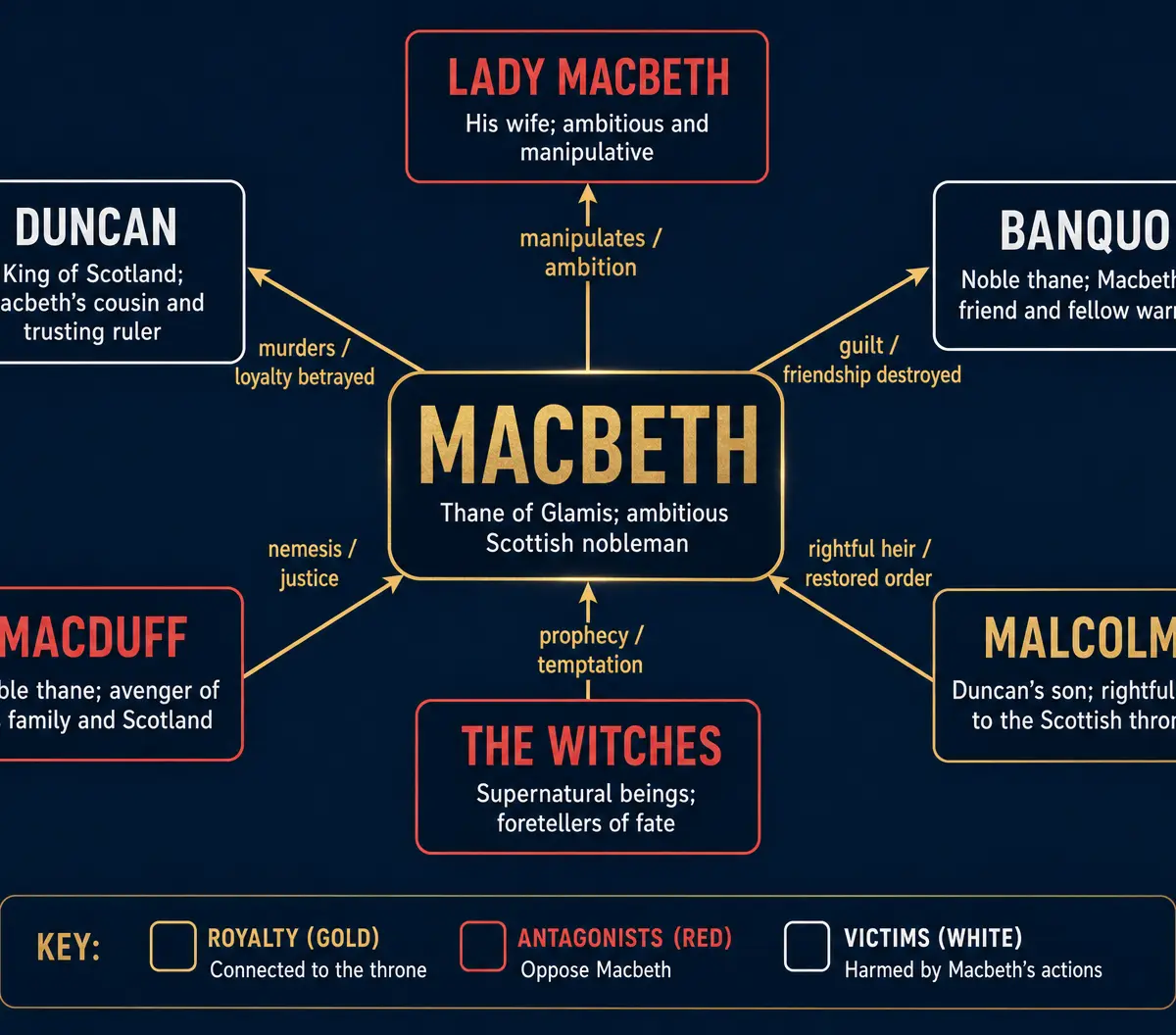
The Tragic Hero (e.g., Macbeth, Romeo)
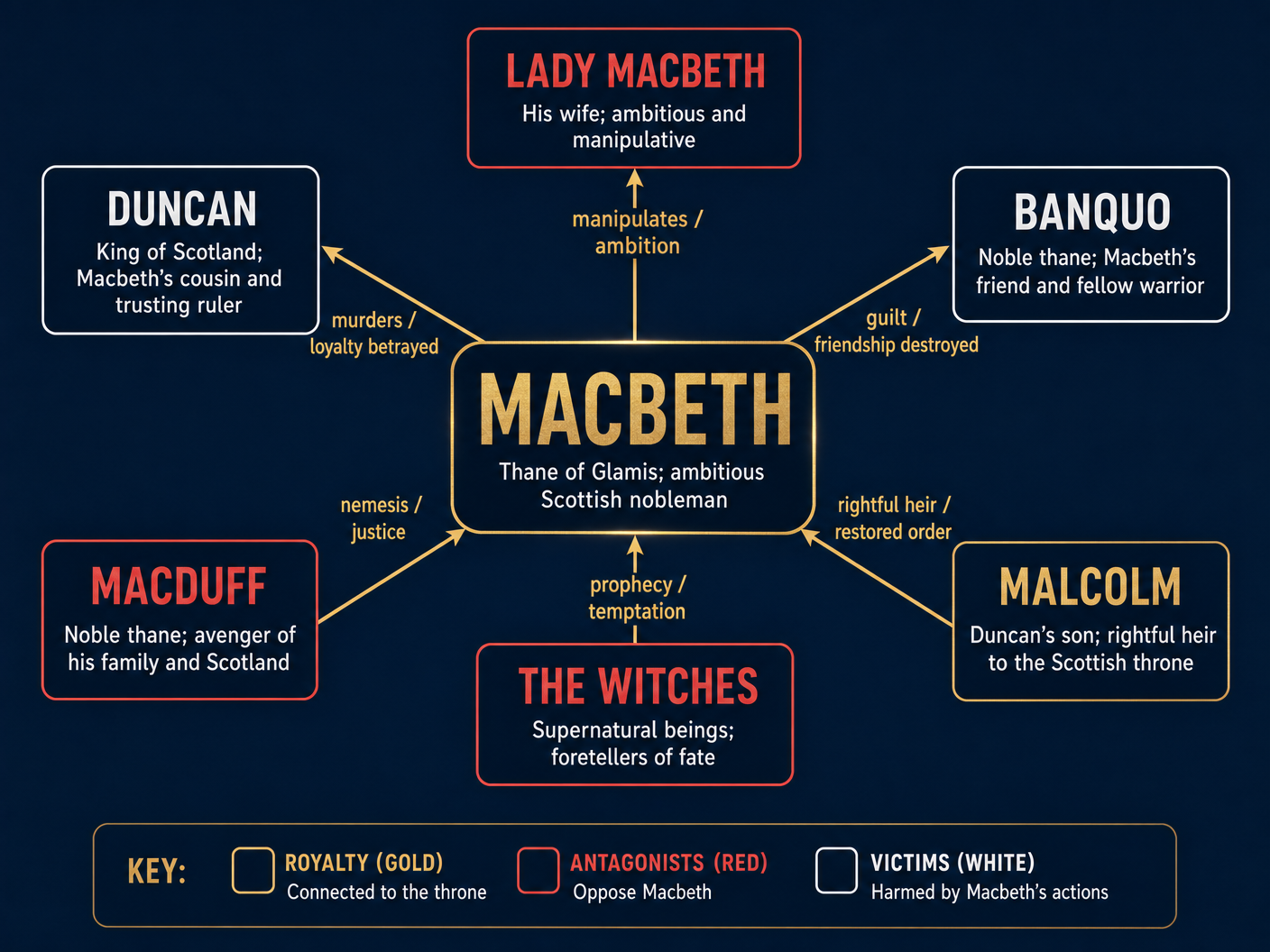
Role: The protagonist whose fatal flaw (hamartia) leads to their downfall.
Key Traits: Noble origins, intense internal conflict, capacity for great violence or passion.
Character Arc: Moves from a position of honour and integration to isolation, madness, and death.
Essential Quotes:
- "O, full of scorpions is my mind, dear wife!" (Macbeth) - The metaphor of scorpions vividly illustrates his psychological torment.
- "O, I am fortune's fool!" (Romeo and Juliet) - Recognises his lack of agency against fate.
The Catalyst/Manipulator (e.g., Lady Macbeth, Iago, The Witches)
Role: Drives the plot forward by exploiting the weaknesses of others.
Key Traits: Cunning, persuasive, often associated with the supernatural or the 'Other'.
Character Arc: Often loses control of the chaos they initiate.
Essential Quotes:
- "Look like the innocent flower, but be the serpent under't" (Macbeth) - Lady Macbeth's imperative command relies on natural imagery to advocate for unnatural deception.
Writer's Methods
Examiners (AO2) require you to analyse how Shakespeare constructs meaning:
- Verse vs Prose: Noble characters speak in blank verse (unrhymed iambic pentameter) to show status and control. Lower-class characters, or nobles losing their minds (like Lady Macbeth in Act 5), speak in prose.
- Dramatic Irony: When the audience knows something the characters do not. This creates tension and complicity.
- Soliloquy: A character speaking their inner thoughts aloud alone on stage. Essential for revealing true motives and psychological state.
- Imagery and Motif: Recurring symbols (blood, light/dark, clothing, disease) that reinforce thematic ideas.
Context
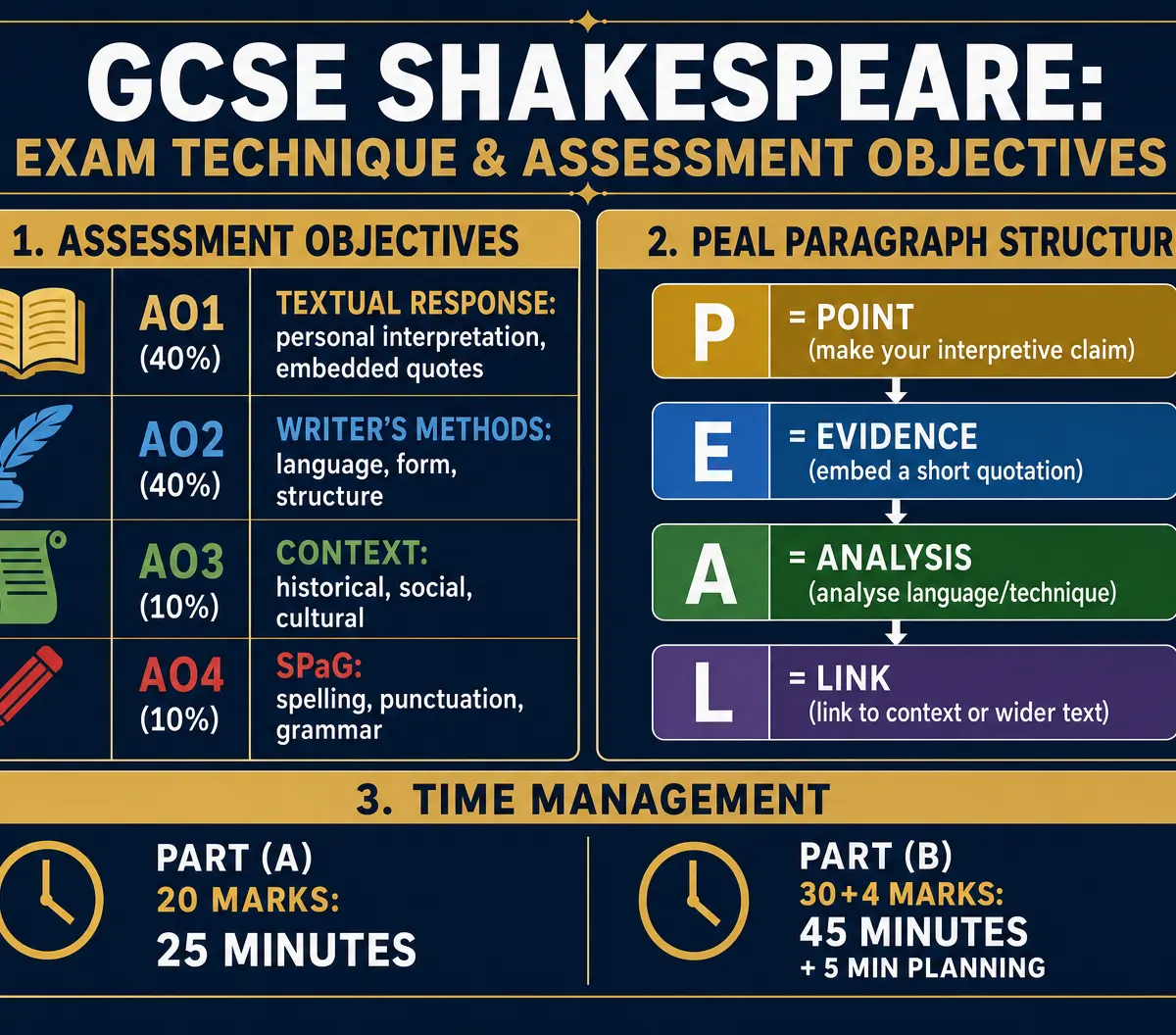
To hit AO3, you must integrate contextual knowledge smoothly into your analysis. Do not 'bolt it on' as a separate paragraph.
- The Great Chain of Being: The Elizabethan/Jacobean belief in a strict, God-ordained hierarchy. Regicide or rebellion disrupts not just politics, but the cosmos itself (e.g., the unnatural weather in Macbeth).
- Patriarchy and Gender: Society was strictly patriarchal. Women were property of their fathers or husbands. Characters like Lady Macbeth, Beatrice, or Juliet who defy these norms would be seen as transgressive or dangerous.
- The Supernatural: King James I was obsessed with witchcraft (writing Daemonologie). The inclusion of witches in Macbeth catered directly to the monarch's fears and the public's genuine belief in the occult.
- The Renaissance: A period of intellectual awakening, questioning old certainties, and exploring humanism (evident in The Tempest and the complex psychology of the characters).
Visual Resources
3 diagrams and illustrations
Interactive Diagrams
1 interactive diagram to visualise key concepts
Conceptual Flow Outline
Shakespearean Five-Act Structure (Freytag's Pyramid)
Worked Examples
2 worked examples — open one to explore the question and available guidance.
Practice Questions
Test your understanding — click to reveal model answers
Starting with this extract, explore how Shakespeare presents the theme of ambition in Macbeth. (30 marks + 4 AO4)
Hint: Consider how ambition is introduced as a 'black and deep desire', how it requires the subversion of nature (Lady Macbeth), and how it ultimately leads to paranoia and ruin.
Starting with this extract, explore how Shakespeare presents the relationship between parents and children in Romeo and Juliet. (30 marks + 4 AO4)
Hint: Look at Lord Capulet's shift from a protective father in Act 1 to a violent, tyrannical patriarch in Act 3.
Starting with this extract, explore how Shakespeare presents the character of Prospero in The Tempest. (30 marks + 4 AO4)
Hint: Track Prospero's journey from a vengeful, controlling sorcerer to a man who chooses mercy and relinquishes his power.
Starting with this extract, explore how Shakespeare presents deception and disguise in Twelfth Night. (30 marks + 4 AO4)
Hint: Consider literal disguise (Viola as Cesario) versus psychological self-deception (Orsino, Malvolio).